
Google Analytics 4 has introduced a dedicated AI Assistant channel within its Default Channel Group, making it easier to identify website traffic generated by AI platforms. Previously, visits from AI assistants could be categorised as referral traffic, making it harder to understand how much visibility and engagement a business was gaining through generative AI.
The update gives marketers a clearer way to measure this emerging source of website traffic without relying on custom channel groups or manually maintained rules. For businesses investing in SEO, content, and AI search visibility, it provides another useful layer of insight into how people are discovering their websites.
This article explains what the new AI Assistant channel does, how GA4 categorises this traffic, what has changed for existing reporting setups, and what businesses should consider when analysing their AI-generated traffic.
Key Takeaways
- Google Analytics now has an AI Assistant channel within its Default Channel Group for traffic identified as coming from recognised AI assistants.
- GA4 automatically assigns the
ai-assistantmedium and(ai-assistant)campaign value when a recognised AI assistant referrer is detected. - AI Assistant reporting depends on identifiable referral information, so some visits generated through AI platforms may still appear elsewhere, particularly when no referrer is passed.
What is the new AI Assistant channel in GA4?
Google has introduced AI Assistant as a new channel within the Default Channel Group in Google Analytics 4. The channel is designed to identify visits that arrive through recognised AI assistants, including platforms such as ChatGPT, Gemini, Claude, Perplexity, Copilot, and Grok.
Google also specifies that traffic from its AI Overviews and AI Mode is excluded from this channel and remains within Organic Search.
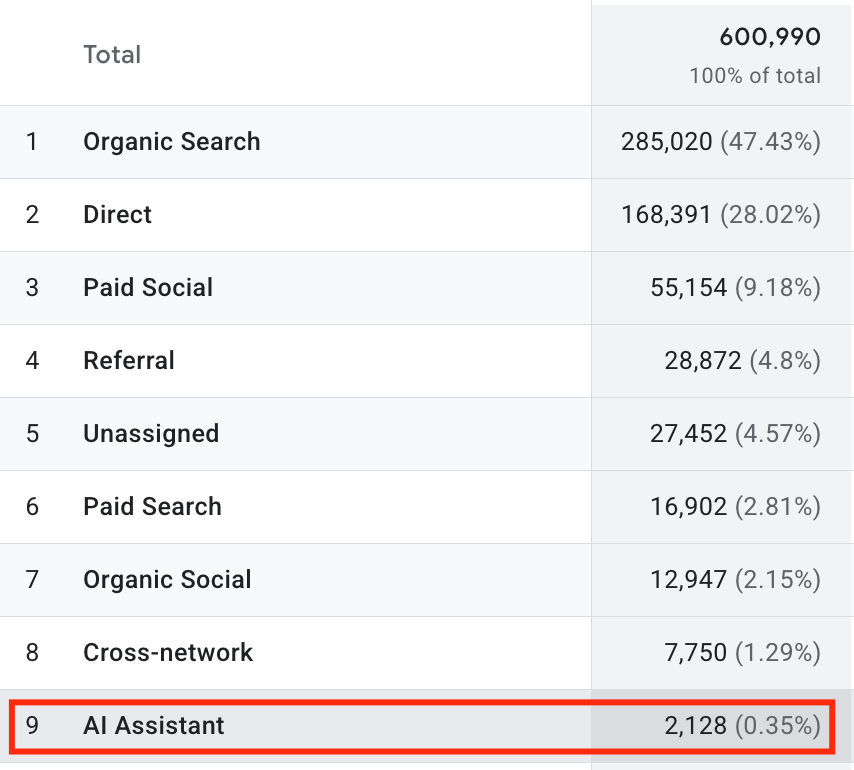
This gives businesses a dedicated way to assess traffic generated by AI assistants alongside established acquisition channels such as Organic Search, Paid Search, Referral, and Organic Social.
The change is particularly relevant as consumers increasingly use AI assistants to research products, services, businesses, and questions before visiting individual websites.
How does GA4 identify AI Assistant traffic?
The new channel works through changes to GA4’s traffic source dimensions.
When Google Analytics identifies a referrer that matches its recognised list of AI assistants, it automatically applies the following values:
| GA4 dimension | New value |
|---|---|
| Medium | ai-assistant |
| Default Channel Group | AI Assistant |
| Campaign | (ai-assistant) |
Google says the changes happen automatically when a recognised AI Assistant referrer is detected. There is therefore no requirement to create a new filter or manually configure a channel group simply to identify this traffic.
The AI Assistant channel can be viewed within relevant acquisition reporting, giving marketers a more straightforward way to analyse the contribution of AI assistants to website traffic and user behaviour.
Why is this change important?
Previously, traffic from AI assistants could be grouped under Referral, making it difficult to distinguish AI-generated visits from other referral sources.
The new AI Assistant channel gives businesses a clearer view of traffic coming from recognised AI platforms. This makes it easier to monitor AI-driven visits, compare their behaviour with other channels, and see whether they contribute to enquiries, purchases, or other key events.
For businesses investing in SEO and AI search visibility, this provides another useful way to understand how changes in the search landscape are affecting website traffic.
Does AI Assistant include every AI platform?
Not necessarily. Google Analytics identifies AI Assistant traffic when a visit comes from a recognised AI assistant and the relevant referral information is available.
Google’s current documentation includes platforms such as ChatGPT, Gemini, Copilot, and Grok. AI Overviews and AI Mode are excluded from the AI Assistant channel and remain within Organic Search.
The channel should therefore be viewed as a way to measure identified AI assistant referrals, rather than a complete measurement of every visit influenced by AI.
What are the limitations of AI Assistant reporting?
There are several factors to consider when interpreting AI Assistant data:
- Not every AI platform will necessarily be recognised: Google maintains a defined list of AI assistants, so traffic from other platforms may be categorised elsewhere.
- Referral data is required: If an AI platform does not pass identifiable referral information, GA4 may not attribute the visit to AI Assistant.
- AI influence does not always result in a click: Someone may discover a business through an AI-generated response and later visit through search, direct traffic, or another route.
- AI Assistant is only one part of AI search measurement: GA4 data should be considered alongside SEO performance, Search Console data, and other visibility measures.
Measure AI search visibility with topclick
AI is changing how people discover businesses online, making visibility across search engines and AI platforms increasingly important. The new AI Assistant channel in GA4 gives businesses a clearer way to measure some of the traffic generated by this changing search behaviour.
However, understanding the data is only part of the process. Businesses also need a strategy that helps them appear in relevant searches and AI-generated responses, while turning that visibility into meaningful website traffic and enquiries.
topclick’s SEO and AI search services help businesses adapt their digital marketing strategy to the changing search landscape. Combining search expertise, content, and technical optimisation, the team can help improve your visibility and make better use of the data available through GA4.
Get in touch with topclick to discuss your SEO and AI search strategy.