

written by
Chris Bland
topclick SEO & Social Manager
SEO is often judged by how much organic traffic a website attracts, but visitor numbers tell only part of the story. Understanding whether those visitors are discovering a business for the first time or returning after an earlier visit can provide further insight into how people find and interact with a brand.
To explore this, topclick analysed Google Analytics 4 (GA4) data from 22 websites over the 12 months between 1 October 2025 and 30 September 2026. The sample includes businesses of different sizes, from smaller companies and start-ups to established SMEs and national brands. Client identities have been kept confidential, and the analysis represents a portion of topclick’s SEO client portfolio, rather than every client we work with.
The findings reveal how organic search users are classified across these websites, with new users accounting for the largest share in the average results. They also highlight the importance of understanding what analytics data can tell us, particularly when cookie consent and privacy choices affect the information available.
What Do New and Returning Organic Search Visitors Actually Mean?
Before looking at the figures, it is worth establishing what new and returning users mean in the context of SEO.
Google Analytics 4 distinguishes between users according to their recorded activity. When we apply this distinction to organic search, we can start to understand whether search is reaching people who are new to a website or attracting people who have visited previously.
What Is a New Organic Search User?
A new organic search user is someone GA4 classifies as new who arrives through organic search. The classification is based on recorded activity, including a first-visit event, and can depend on the website’s analytics setup and available identifiers.
For SEO, this can represent someone discovering a business through an unpaid search result. However, a new user is not necessarily someone who has never heard of the business, as they may have encountered the brand through other channels or visited previously without being recognised by GA4.
What Is a Returning Organic Search User?
A returning organic search user is someone who has visited a website before and returns through organic search, with GA4 recognising their previous activity.
These visitors may be comparing suppliers, researching services, or preparing to enquire. Returning users are particularly relevant for businesses with longer buying cycles, where prospective customers may need several visits before making a decision.
How Much Organic Search Traffic Comes from New Visitors?
To understand the balance between new and returning users, we examined the reported percentages across 22 websites in topclick’s portfolio.
The reporting period covers a full 12 months, between 1 October 2025 and 30 September 2026, helping to account for seasonal changes in website activity.
The figures were supplied through a third-party reporting platform drawing on GA4 data. The analysis uses the percentages available for each website, rather than the total number of users across the combined portfolio.
The Average Split Across 22 Websites
When we calculate the simple average of the reported percentages across the 22 websites, the results are as follows:
| User classification | Average percentage |
|---|---|
| New users | 66.25% |
| Returning users | 25.50% |
| Unclassified remainder | 8.25% |
The unclassified remainder is calculated by subtracting the reported new and returning percentages from 100% for each website, then averaging those remainders.
The figures show that new users account for around two-thirds of the reported organic search user split on the average website in this sample. Returning users account for around a quarter, with the remainder not accounted for by the two supplied percentages.
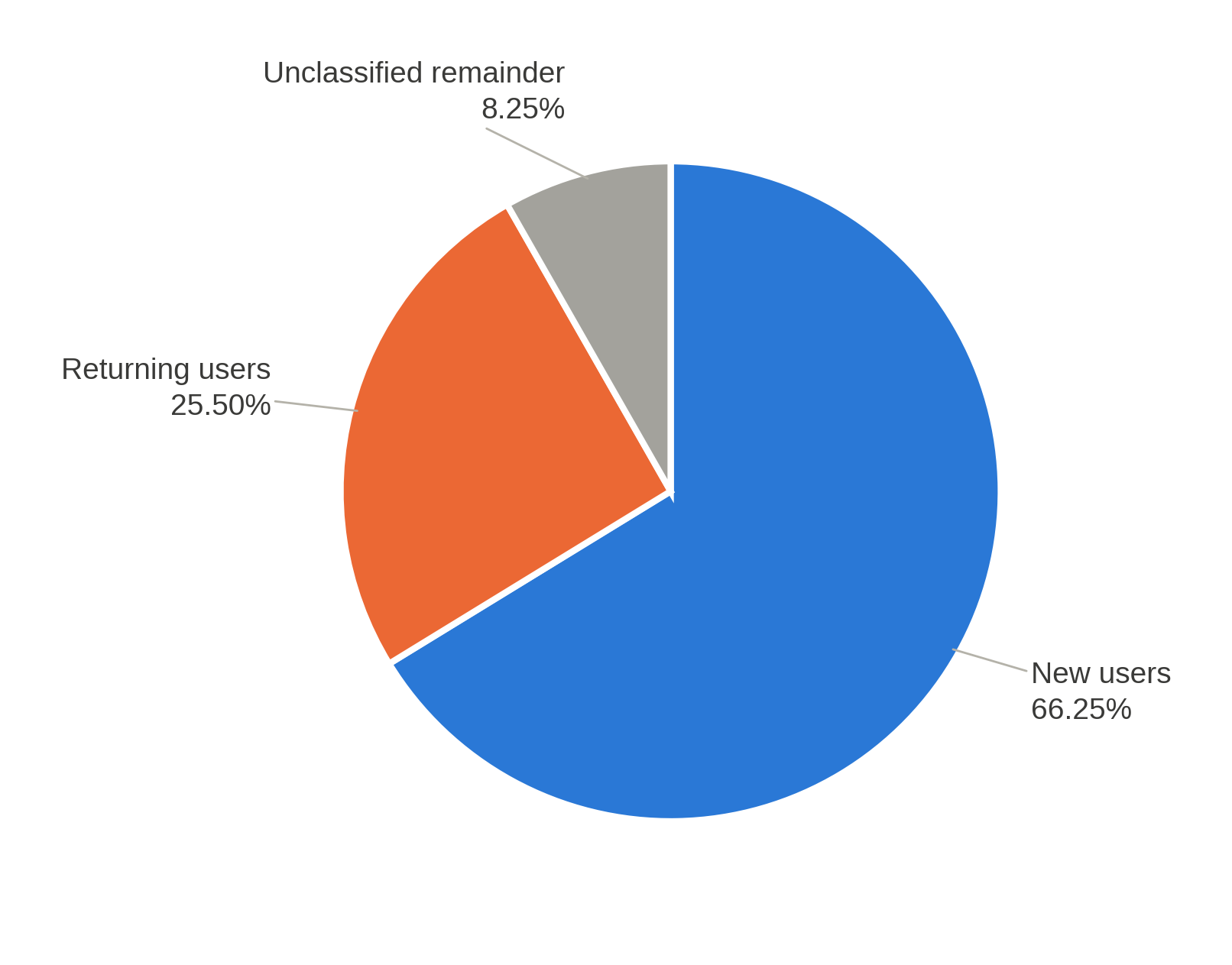
This supports the view that organic search can be an important channel for reaching new audiences. However, it is important to distinguish an average across websites from the combined traffic split across all users. Each website has equal weight in this calculation, regardless of how much organic traffic it receives.
The results also do not establish how many of these users went on to become customers. That requires conversion data and a closer look at what visitors do after arriving on the website.
How Much Does the Split Vary Between Websites?
The averages provide a useful overview, but they do not tell the whole story. Looking at the individual percentages reveals considerable variation across the sample.
| Measure | Lowest reported percentage | Highest reported percentage |
|---|---|---|
| New users | 53.74% | 87.98% |
| Returning users | 9.20% | 37.17% |
| Unclassified remainder | 2.82% | 13.56% |
New users accounted for more than half of the reported split on every website in the analysis. However, the proportion ranged from 53.74% at the lower end to 87.98% at the upper end.
Returning users showed a similarly broad range, representing between 9.20% and 37.17% of the reported split.
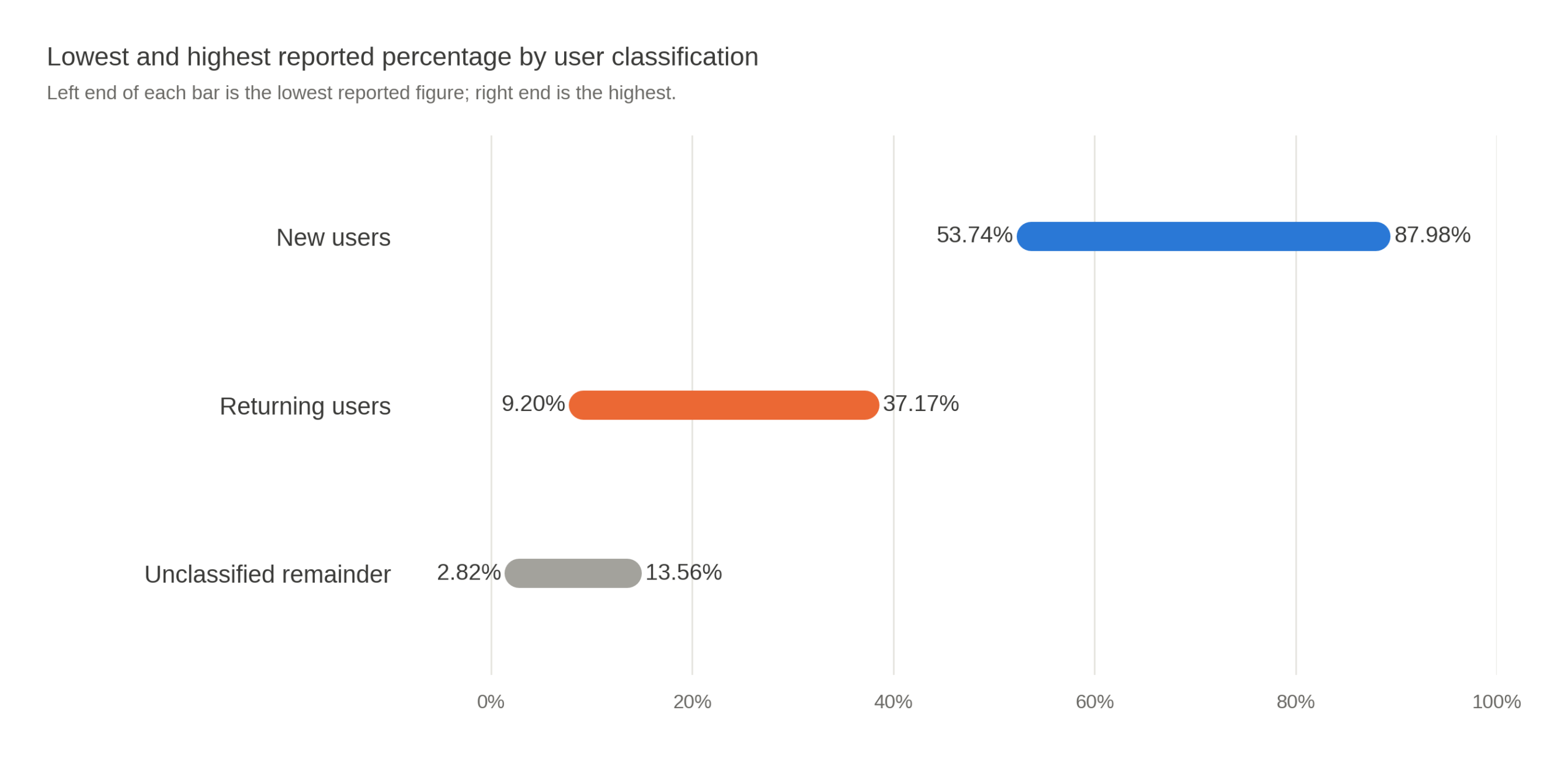
These differences are a useful reminder that websites do not all serve the same purpose. A business attracting people who are researching a service for the first time may have a different visitor profile from a company whose customers regularly return to check products, technical resources, or project information.
The figures alone cannot tell us exactly why these differences exist. Factors such as the industry, buying cycle, website content, brand awareness, and measurement setup could all be relevant. Further analysis would be needed to establish which factors have the greatest influence.
What the data does demonstrate is that a single target percentage for new or returning organic users would be difficult to justify across every business.
Why Is Some Organic Traffic Unclassified?
The third category in our analysis is the unclassified remainder. Across the 22 websites, this remainder averages 8.25%.
How Does Cookie Consent Affect GA4 Data?
Websites using analytics cookies generally need to obtain the appropriate consent before storing or accessing information on a user’s device, subject to the applicable rules and any relevant exemptions. In the UK, these requirements sit alongside wider data protection obligations.
When someone declines analytics cookies, the website’s analytics setup may be unable to collect the same information it would have collected if consent had been granted. Depending on the implementation, this can limit the ability to recognise a visitor across sessions.
Consider someone who visits a website, declines analytics cookies, and returns a week later through another Google search. If the analytics setup cannot recognise the earlier visit, it may not be able to establish that the person has returned.
This creates a measurement challenge. The actual visitor journey has taken place, but the information available to analytics may not fully reflect it.
What Do These Findings Tell Us About SEO?
The data provides a useful starting point for understanding the role organic search plays in attracting new users. However, the visitor split should be interpreted alongside the wider objectives of an SEO campaign.
1. SEO Can Help Businesses Reach New Audiences
With new users accounting for an average of 66.25% of the reported split, the findings show that the new-user category represents the largest share across the websites analysed.
This is consistent with an important role of SEO: helping businesses appear when people search for information, products, or services relevant to their needs.
For a smaller business looking to increase awareness, reaching people who have not previously visited its website can be particularly valuable. Relevant organic visibility creates opportunities to introduce its offering to potential customers who may otherwise be unaware that it exists.
The same principle applies to established brands. Even businesses with strong existing recognition need to reach new audiences if they want to expand into new markets, promote additional services, or maintain a healthy pipeline of potential customers.
However, the percentage of new users is not a direct measure of SEO success. A website might attract a high proportion of new users through searches that have little commercial relevance, while another might attract fewer new users who are much more likely to enquire or buy.
The quality and relevance of that traffic matter just as much as its classification.
2. Returning Visitors Still Matter
The average returning-user percentage of 25.50% also deserves attention.
Someone returning to a website may already understand the business and be further along in their decision-making process. They might be revisiting a service page after an initial search, comparing options, or looking for reassurance before making contact.
This is particularly relevant for services with longer sales cycles, where prospective customers often need time to assess their options before committing.
SEO can support these journeys by ensuring that useful information remains discoverable when people search again. Clear service pages, detailed case studies, and informative articles can all help users find the information they need.
There is an important distinction here: returning users are not necessarily returning because of SEO alone. A person might first discover a business through organic search and later return through direct traffic, email, or another channel. The figures in this analysis concern the reported organic search user split, rather than every return visit across all channels.
Understanding that distinction helps businesses assess SEO in the context of the wider customer journey.
Why the Right Metrics Matter More Than a Universal Target
The 22 websites show why there is no single ideal balance of new and returning users. What matters depends on the website’s goals.
A business looking to reach new customers may focus on attracting relevant new users, while a business with a longer sales cycle may place more emphasis on bringing visitors back.
To understand their SEO performance, businesses should also look at:
- Organic search visibility: Are the right people finding the website?
- Conversions: Are visitors making enquiries or purchases?
- Engagement: Are visitors interacting with important pages and content?
These metrics help show whether SEO is delivering meaningful results, rather than simply increasing traffic. If a website attracts new users but receives few enquiries, for example, it may be worth reviewing the landing pages or how clearly the business communicates its services.
Ultimately, the focus should be on attracting the right visitors and turning that traffic into meaningful results, rather than aiming for a particular percentage of new or returning users.
Improve Your Organic Search Performance with topclick
Understanding who visits a website is one part of building an effective SEO strategy. The next step is using that information to identify opportunities, improve visibility for relevant searches, and attract visitors who are more likely to become customers.
topclick works with businesses across a range of industries to develop data-led SEO strategies tailored to their objectives. By analysing organic search performance alongside the wider picture of website activity, we can help businesses understand where opportunities exist and what improvements are most likely to make a difference.
Whether you want to increase relevant organic traffic, improve the performance of important landing pages, or generate more enquiries through search, our SEO team can help you develop a strategy based on your business and its goals.
Get in touch with topclick to discuss how our SEO services can help your business grow its organic search performance.